My knowledge OS that’s like a second brain.
A personal knowledge OS that compiles everything I read and ship into an interlinked markdown wiki, so my knowledge and project status compound instead of evaporating across AI chats and scattered folders.
The knowledge to run a consistent solo studio lived nowhere.
I run NAZO Collective solo: three products in flight (CYPHR, FLAVORS, and Aurea/Sage) plus a design practice. Every AI chat used to start from zero and vanished once I closed it, project status went stale across a dozen Desktop folders, and I kept re-researching the same things.
My constraints were self-imposed and real: plain markdown only for portability and git history, Claude Code as the engine, Obsidian as the frontend, and one hard requirement that the system had to maintain itself. If keeping it current took discipline I did not have, it would rot.
What affects my project outcomes:
Compile, do not retrieve.
Retrieval is the common way to use AI on documents: locate chunks of info, assemble an answer, keep nothing. It never improves. The real bottleneck of any knowledge base is bookkeeping, not thinking. So when files are added to NAZO OS, the LLM reads a source and integrates it into interlinked pages, updating existing articles and backlinks so knowledge compounds.
One source of truth.
Every claim traces back to an immutable capture. The source layer is append-only and never edited after capture, so the wiki can never float free of what it came from. That single rule is what separates a knowledge base from a bunch of confident guesses.
Knowledge and command center centrally-located.
I merged the resulting wiki with living project dashboards, so the same system is both my brain and my command center. A new work session gets full context by reading one file, and stale project status gets caught because status lives alongside the knowledge.
Three commands, one rulebook.
The system runs on three one-word commands: /ingest captures a source and weaves it into the wiki, /query returns cited answers pulled from pre-built pages, and /lint health-checks for broken links, orphans and stale status. A CLAUDE.md schema is the single rulebook that keeps the agent disciplined instead of working as a generic chatbot.
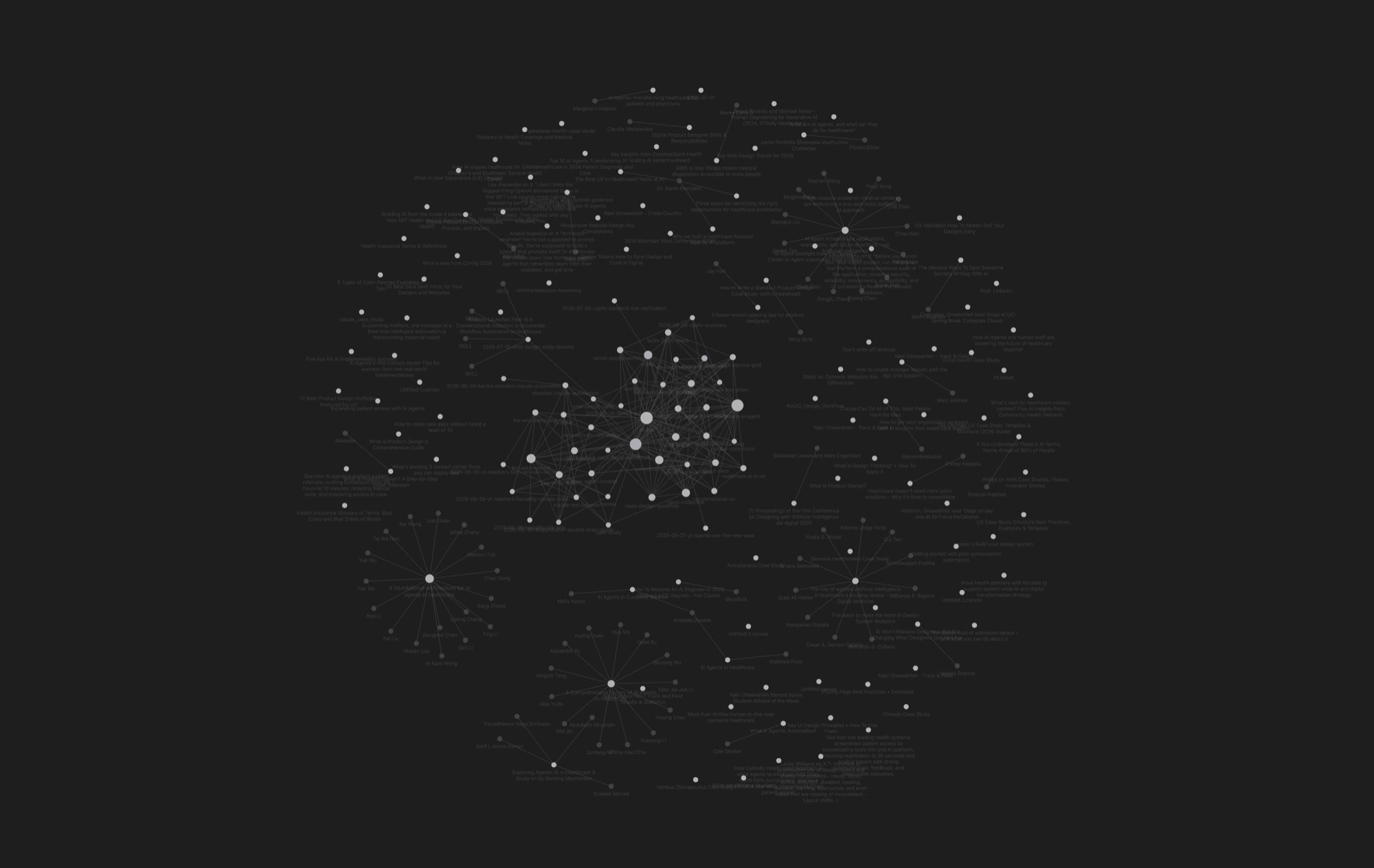
Every source I ingest becomes a node and links itself to related knowledge. The clusters are not organized by hand. The LLM does the linking on ingest, which is the whole point.
Knowledge that compounds, and catches its own mistakes.
92 sources → 28 articles
I compiled 92 captured sources into 28 cross-linked articles and 4 self-updating project dashboards, all traceable to source.
Caught stale status
The command-center half flagged CYPHR as blocked when it was actually launch-ready, a miss a folder-based system had made.
Build-ready knowledge base
I stood up the healthcare agent’s base: all 18 insurance plans with complete deductible, out-of-pocket and per-service copay grids extracted from scanned PDFs.
One-file context
A new work session gets full context by reading one file. The system documents how it was built, including this case study.
“The discipline I almost cut is the one that makes it trustworthy: every claim traces to a capture.”
It is tempting to let the wiki float free of its sources, but the append-only source layer is what separates a knowledge base from a pile of confident guesses. The second lesson: a knowledge tool lives or dies on its frontend. The data is just markdown; Obsidian’s graph is what makes the compounding visible, which is what makes me trust it and keep feeding it.